


Over the past two decades, football has struggled to fully describe Lionel Messi’s brilliance.
The goals kept coming. The trophies kept arriving. The records kept falling. Yet somehow, on Tuesday night in Kansas City, the Argentina’s little maestro found another piece of history that had eluded him.
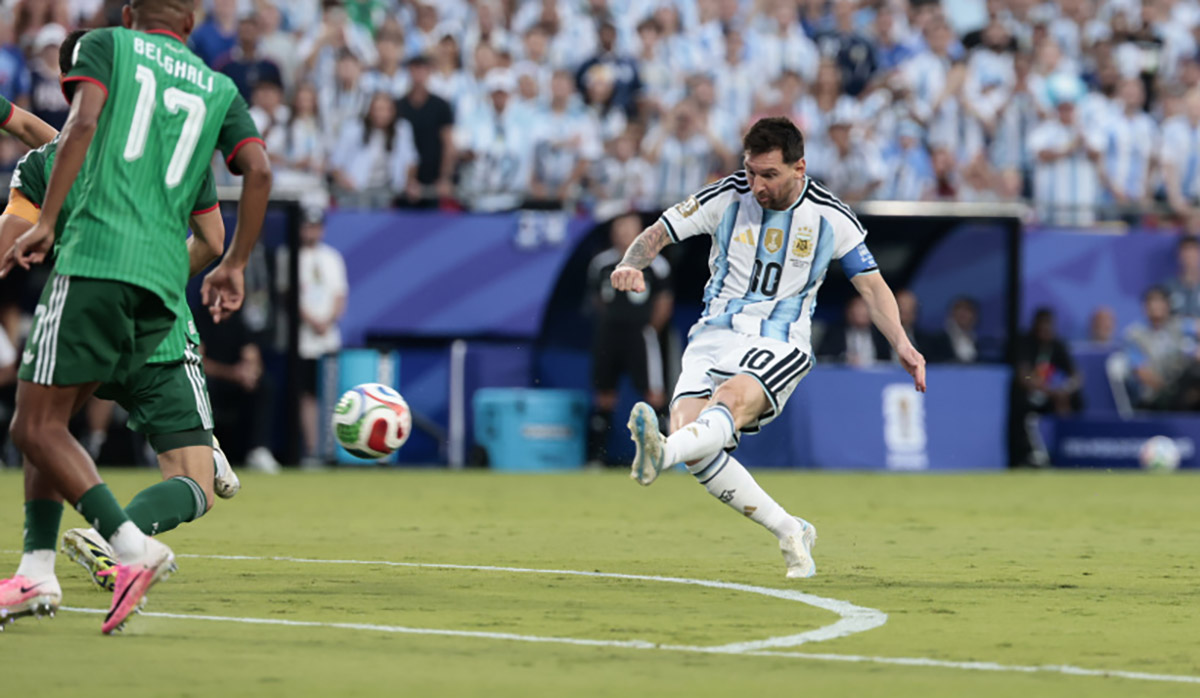
Against Algeria at the FIFA World Cup, Messi scored the first World Cup hat-trick of his extraordinary career, which was a remarkable achievement on its own.
But when placed alongside the circumstances surrounding it, the performance became something much larger on a night that may ultimately stand among the most significant individual milestones the tournament has ever witnessed.
The World Cup hat-trick that took 20 years
Twenty years earlier, on June 16, 2006, a teenage Messi scored his first World Cup goal against Serbia and Montenegro in Germany.
Exactly two decades later, and after 27 World Cup appearances spread across six tournaments, he finally completed a World Cup hat-trick.
The symmetry feels almost too perfect.
For a player who has collected virtually every honour football can offer, the absence of a World Cup hat-trick had become one of the few remaining accolades on his resume.
Before this match, Messi’s 13 World Cup goals had largely arrived one at a time. Even his most famous World Cup performance (the 2022 final against France) produced a brace rather than a treble.
The missing piece is missing no longer. However, the hat-trick was only part of the story.
The oldest World Cup hat-trick scorer
At 38 years and 357 days old, Messi also became the oldest player ever to score a World Cup hat-trick. The previous record belonged to Cristiano Ronaldo, who was 33 years and 122 days old when he scored three times against Spain at the 2018 World Cup in Russia.
Records in football are often broken by months or weeks. But here is Messi, who shattered the one set by one of his greatest rivals by more than five years.
That fact alone illustrates the extraordinary nature of his longevity. Football’s greatest stage has historically belonged to players at their physical peak. Yet at nearly 39 years old, Messi continues to perform at a level few thought possible.
And then came the statistic that elevated the evening into football immortality.
Joint all-time leading World Cup scorer
The three goals took Messi’s World Cup tally from 13 to 16, drawing him level with Germany’s Miroslav Klose as the joint-leading scorer in men’s World Cup history.
For years, Klose’s mark appeared untouchable. The German striker accumulated his 16 goals across four tournaments between 2002 and 2014 and sat alone atop the scoring charts for more than a decade.
Now he has company.
In reaching the summit, Messi also moved beyond two other giants of the game.
Brazil’s Ronaldo Nazario, whose 15 World Cup goals once seemed the gold standard for modern forwards, was overtaken. So too was France’s Just Fontaine, whose astonishing 13-goal haul at the 1958 World Cup remains one of the tournament’s most famous records.
And now, the next milestone already looms.
One more World Cup goal would leave Messi standing alone on 17, the outright men’s record. It would also draw him level with Brazil’s Marta for the most goals scored by any player, male or female, in World Cup history.
Whether that record arrives or not almost feels secondary. Because long after scores are forgotten and tournaments fade into memory, June 16, 2026 will always be remembered as the night when Lionel Messi announced himself to the world. Yet again.