


For more than three decades, the FIFA World Cup has thrived on disorder.
Rankings have offered guidance rather than certainty, and underdogs have routinely dismantled predictions and rewritten tournaments. Every four years, somewhere along the knockout path, one heavyweight has almost inevitably fallen.
Until now.
The 2026 FIFA World Cup has delivered a statistical first that is as remarkable as any dramatic comeback or giant-killing upset.
For the first time since the FIFA Men’s World Ranking was introduced in December 1992, the world’s top four ranked nations have all reached the semi-finals of the same World Cup.
France, Argentina, Spain, and England all validated every expectation attached to them, surviving a tournament specifically designed to make that outcome less likely.
It is the kind of milestone that may not command the same attention as a last-minute winner, but it could ultimately become one of the defining stories of the 2026 tournament.
Why the perfect bracket never happened before
For decades, World Cups have resisted perfection. Knockout football has consistently exposed favourites to the randomness that makes the competition so compelling.
Form disappears over 90 minutes. One mistake, one penalty shootout, or one moment of brilliance has often been enough to derail even the strongest contenders. And history is littered with examples.
Morocco, ranked 22nd, stunned both Spain and Portugal en route to the semi-finals in 2022.
Croatia, ranked 20th, shocked the world by surging all the way to the championship match in 2018, before proving it was no fluke by returning to the final four once again in 2022.
In 2002, co-host South Korea and Turkey, ranked 40th and 22nd respectively, produced one of the most unexpected final fours in tournament history.
Even the closest previous attempt at a perfect semi-final bracket ultimately fell short.
In 2014, Germany, Brazil, Argentina and the Netherlands all reached the last four, yet Spain (the world’s top-ranked team that year) had already crashed out in the group stage.
The pattern was always the same. Rankings pointed in one direction. The World Cup pulled in another. The 2026 edition, however, has done the opposite.
What makes this achievement in 2026 even more striking is that it arrived during the first World Cup featuring 48 teams.
FIFA’s expanded format increased the number of knockout matches by introducing a Round of 32, meaning every eventual semi-finalist had to survive an additional single-elimination test before reaching the quarter-finals.
The route became longer, the opportunities for an upset multiplied, and the mathematical odds of all four elite teams surviving together became even slimmer.
But the favourites refused to blink.
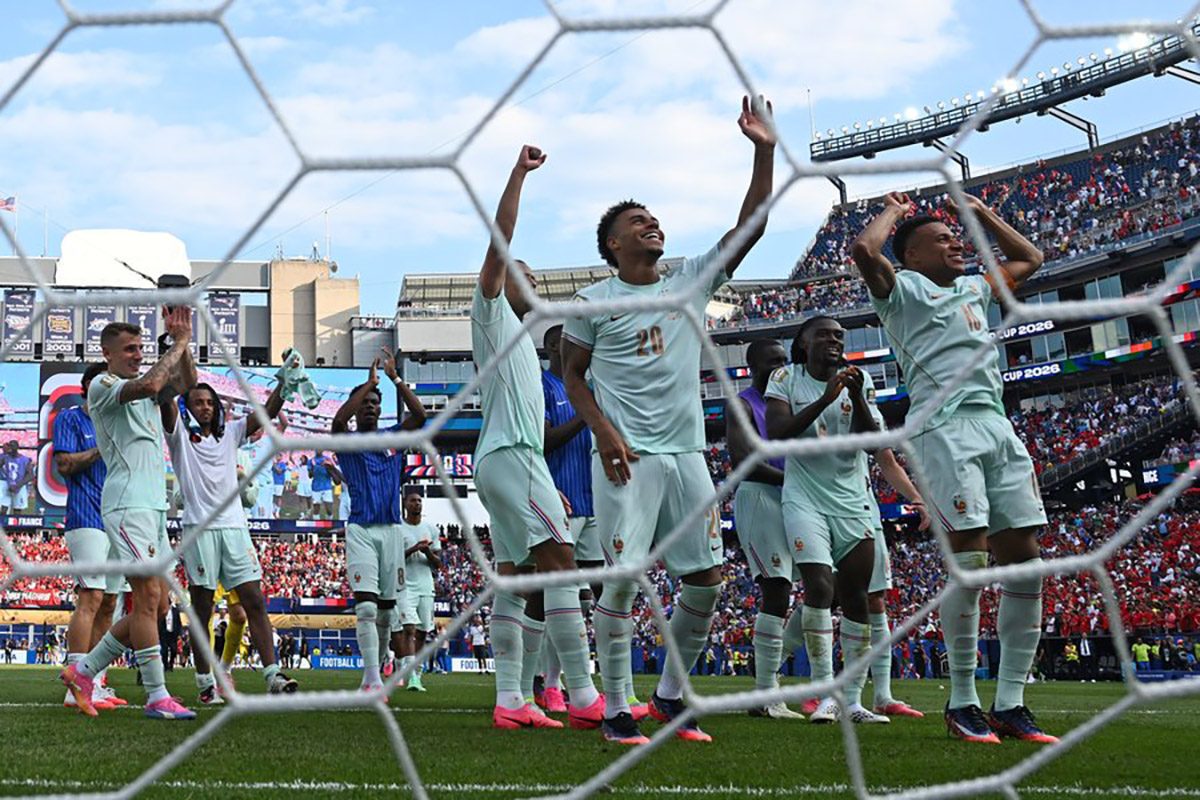
France surged into the world’s No. 1 ranking after eliminating Sweden, Paraguay, and Morocco, reclaiming the top spot by a razor-thin margin during the tournament.
Argentina, despite surrendering the top ranking by the narrowest of margins, continued its title defence by overcoming Cape Verde, Egypt, and Switzerland, the latter after extra time.
Spain maintained its place among the game’s elite by dispatching Austria, Portugal, and Belgium, while England navigated perhaps its sternest examination, requiring 120 gruelling minutes to eliminate Norway in the quarter-finals.
Collectively, they transformed what should have been a chaotic bracket into one that reflected the global hierarchy with unusual precision.
Now the tournament reaches its most anticipated chapter.
France will meet Spain in Arlington (Dallas), where Kylian Mbappe faces the emerging brilliance of Lamine Yamal in a clash between Europe’s current superpowers.
Twenty-four hours later, Argentina and England will renew one of international football’s most enduring rivalries in Atlanta, with Lionel Messi seeking another World Cup final against a new English generation led by Jude Bellingham.
But regardless of who becomes world champion, the 2026 FIFA World Cup has already produced something that previous generations never witnessed.
It is the sight of the world’s four best teams proving exactly why they belong at the top.